In the Figurative section, Francesco Sandirocco’s exhibition journey reveals a creative energy capable of generating forms and places inspired by the seemingly tangible world—transformed by the artist’s touch into evocative images of an “other” dimension, where the time of earthly things is suspended. Here, we are placed in dialogue between perceived reality and the mystery beyond: an invitation to explore new states of inner awareness.
The works presented do not merely represent subjects (faces, bodies, environments); they activate them, question them, and render them protagonists of a dimension in which form becomes the bearer of meaning.
Visiting the “Figurative” gallery, one perceives a research path in which figuration becomes a bridge between the external world and the intimate spaces of consciousness. These are spaces permeated by a light not produced by any identifiable physical source such as a sun or a star, but by that light beyond time and space which only our most authentic essence can recognize as the one capable of revealing the true state of things.
The chromatic rendering, compositional structure, and treatment of light contribute to creating a tension between what appears and what remains suspended. The figures, through their postures and relationships with the surrounding space, suggest a silent narrative: relationships are activated, memories are evoked, multiple interpretations are invited. In this way, painting becomes both gesture and reflection.
From a professional perspective, this section stands out for several key elements:
Stylistic coherence: despite the heterogeneity of subjects, a clear and recognizable line unifies the body of work. Technical mastery and visual sensitivity: line, color balance, and surface treatment are fully at the service of the image-figure. Carefully curated visual experience: the online gallery maintains a layout that facilitates observation, allowing visitors to engage with the works calmly and appreciate their details.
In conclusion, the Figurative section of Francesco Sandirocco’s gallery positions itself as a professional reference point for those seeking contemporary figurative art capable of combining rigor, sensitivity, and personal vision. It may represent a moment of intense engagement for collectors, curators, and art enthusiasts who wish to encounter a pictorial language that lives in the present while remaining rooted in the tradition of the figure.
Rino Sabella
Curator and Art Critic
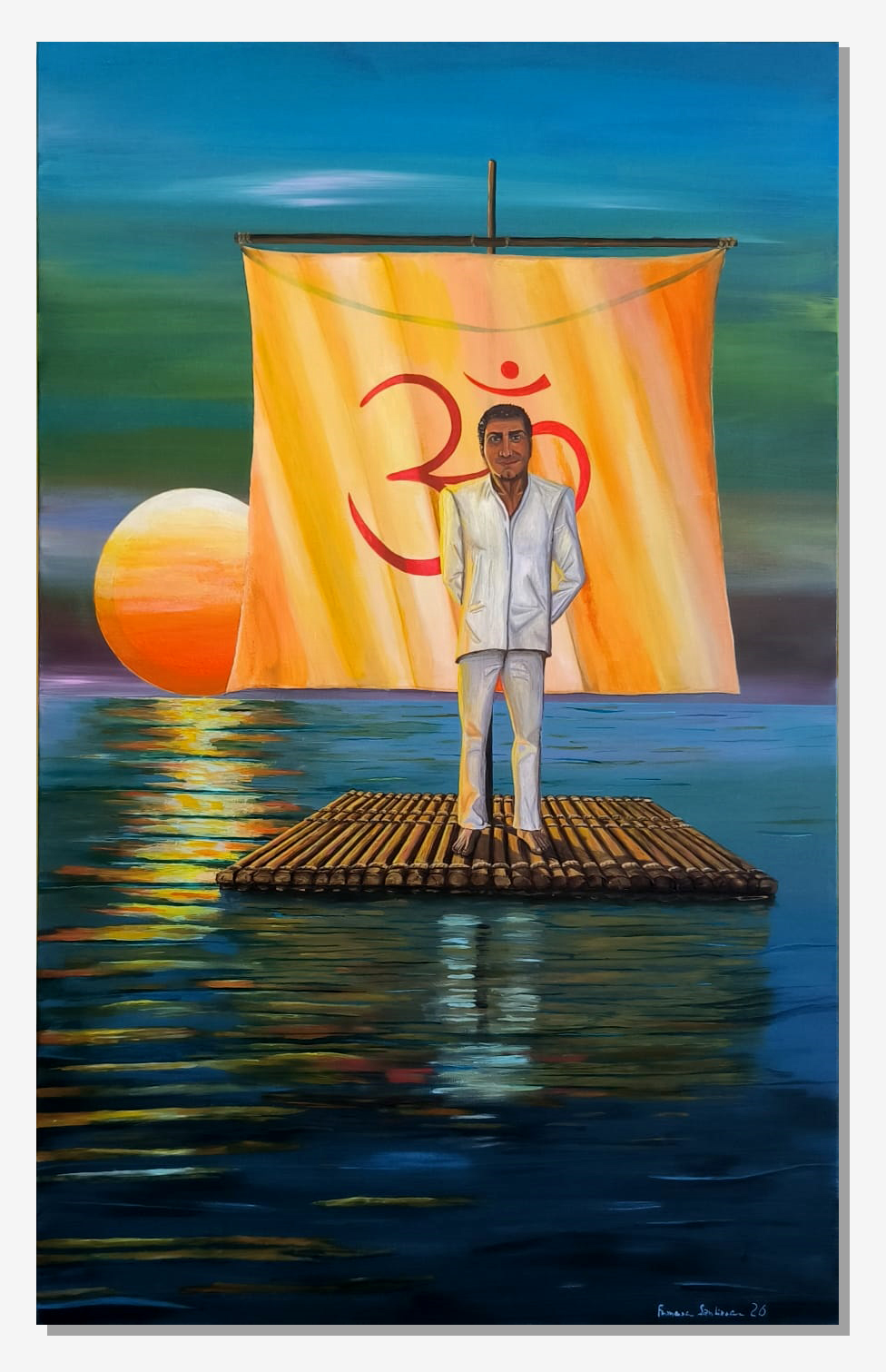
Windless
Year: 2026
Dimensions: 50 x 80 cm
Technique: Acrylic on canvas
Code: FS_2026_006
This painting was born as a wish.
The figure portrayed is a dear friend, suspended between sky and sea, in a moment where everything seems to come to a standstill.
The raft supports him, simple and fragile, while around him the world grows quiet: the wind falls still, the water softens, the light embraces everything.
Behind him, the Om symbol resonates silently, like a deep breath, like a return to what truly matters.
There is no direction, no urgency. Only presence.
“Windless” is a wish for stillness.
It is the hope of finding peace even when the journey cannot be controlled, of remaining centered as everything slows down, of embracing silence without fear.
An invitation to simply be.
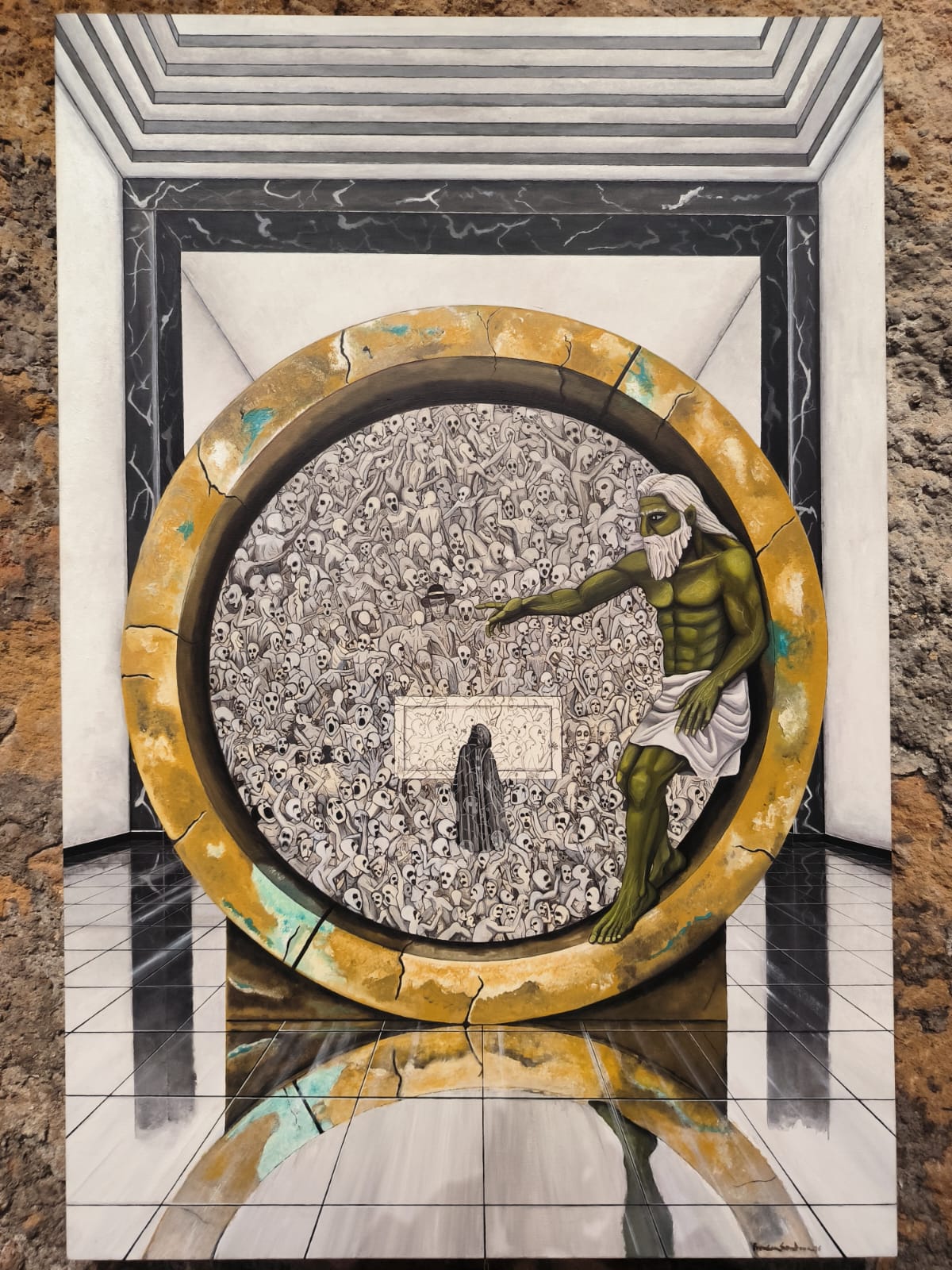
The wheel of time
Year: 2026
Dimensions: 100 x 150 cm
Technique: Acrylic on canvas
Code: FS_2026_004
“The Wheel of Time” presents itself as a sculptural installation set within an art gallery—a rational, geometric, almost metaphysical space. The polished floor reflects the monumental structure, amplifying the illusion and suggesting that what we observe is not merely form, but a threshold. At the center stands a great golden wheel, marked by cracks and the wounds of time. It is cut—like by an invisible fracture—from one to seven o’clock: a line that interrupts the apparent perfection of the circle, insinuating that the cycle is not closed, that an escape exists, however hidden. Within the wheel moves a multitude of imprisoned souls, overlapping, indistinct, compressed into an eternal return. They inhabit another dimension, a plane suspended between life and stasis, as if time itself had become matter. Guarding this metaphysical mechanism is an ambivalent figure: a Zeus/devil—green, muscular, ancient yet demonic. He is not merely a guardian, but a principle—the force that governs the cycle, the custodian of endless repetition. Yet inside the wheel, in a further inner space, a hooded figure can be glimpsed. Solitary and withdrawn, this presence contemplates a blank canvas. It does not fight or attempt to break the mechanism. Its gaze is directed toward emptiness—toward possibility. The white canvas becomes a symbol of purity of thought, of awakening consciousness. It is the silent guide toward the exit: not an external savior, but an act of awareness. The meaning of the work is rooted in the human condition. The wheel is not only time, but the mental pattern—the cycle of habits, fears, and inner repetitions. The guardian, ultimately, is ourselves: the part that fears change and prefers eternal return to the vertigo of freedom.
The piece draws inspiration from a visionary experience lived by a close friend of the painter, who remained in a coma for months. During that suspended time, he experienced several visions; in one, he found himself in an art gallery where The Wheel of Time was displayed as a sculpture. He knew that if he entered it, he would remain trapped. Yet he could not resist: he crossed that threshold and remained imprisoned for an immeasurable span, until something—perhaps the very awareness embodied by the hooded figure—set him free. The wheel, therefore, is not a final condemnation. It is a trial. A passage. Both delirium and revelation. “The Wheel of Time” does not speak of hell, but of the mind. It does not represent punishment, but a cycle that can be broken. The fracture cutting across the circle is the sign that every eternity contains a breaking point. And the way out is not outside the wheel. It lies within the gaze.
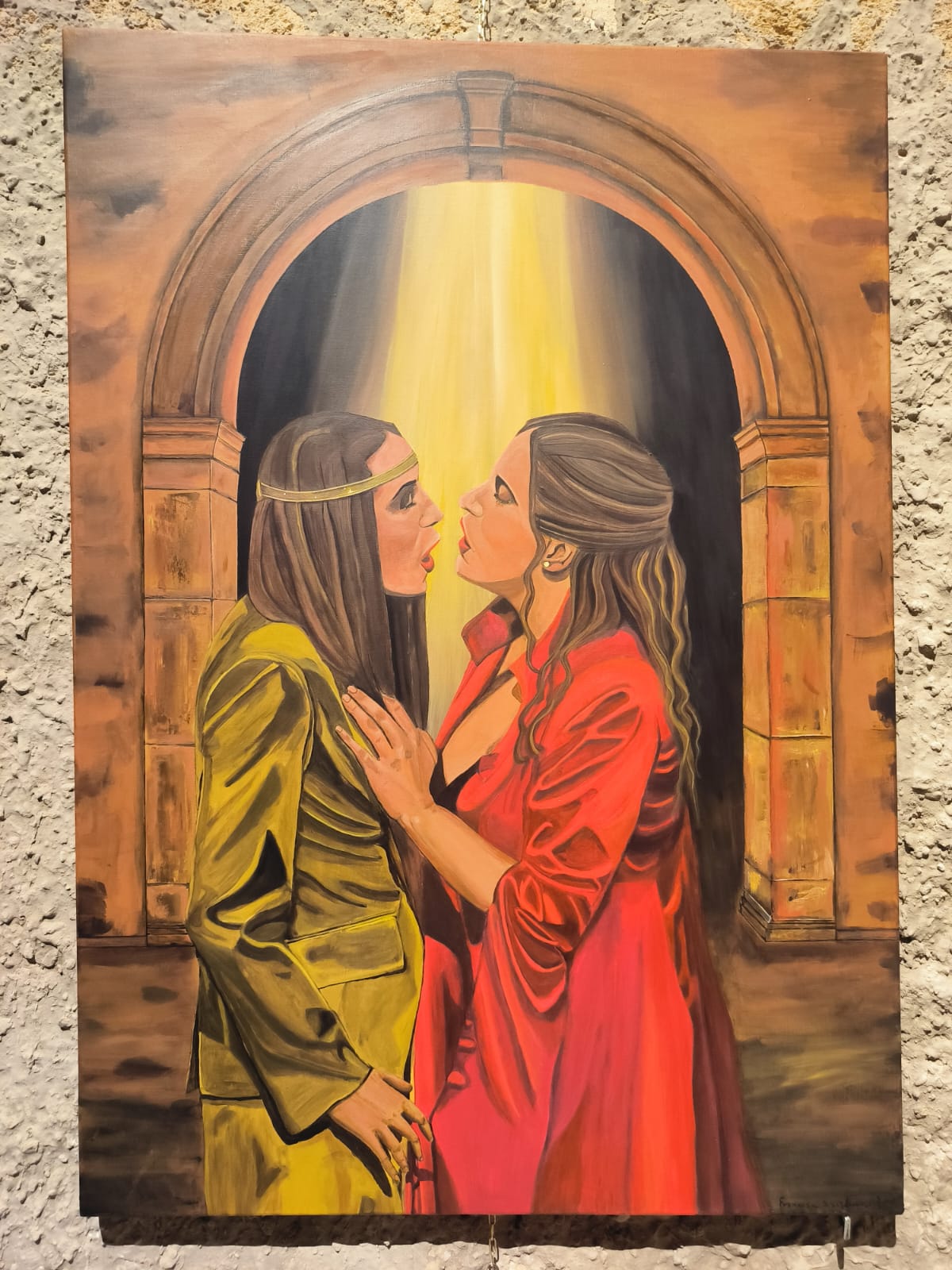
The fire of Rome
Year: 2026
Dimensions: 70 x 100 cm
Technique: acrylic on canvas, gesso
Code: FS_2026_005
Under an arch reminiscent of the monumentality of Rome, Nero and Poppea touch each other in a moment suspended between desire and destiny. The light that envelops them is not only revelation, but combustion: the fire of love, absolute and all-encompassing, already contains within itself the omen of destruction. The passion that unites the two lovers becomes a metaphor for the fire that burned Rome: an unbounded energy, capable of overwhelming all balance. The figure of Nero, played by a woman in accordance with the tradition of Monteverdi’s opera, emphasises the divine power of the daimon Eros, who frees human beings from the blind cultural conditioning to which the body is subjected. Furthermore, love expressed through two female bodies, without diminishing its undoubted beauty and authenticity, unwittingly becomes a metaphor for the dangerous link between power and seduction, fragility and domination.
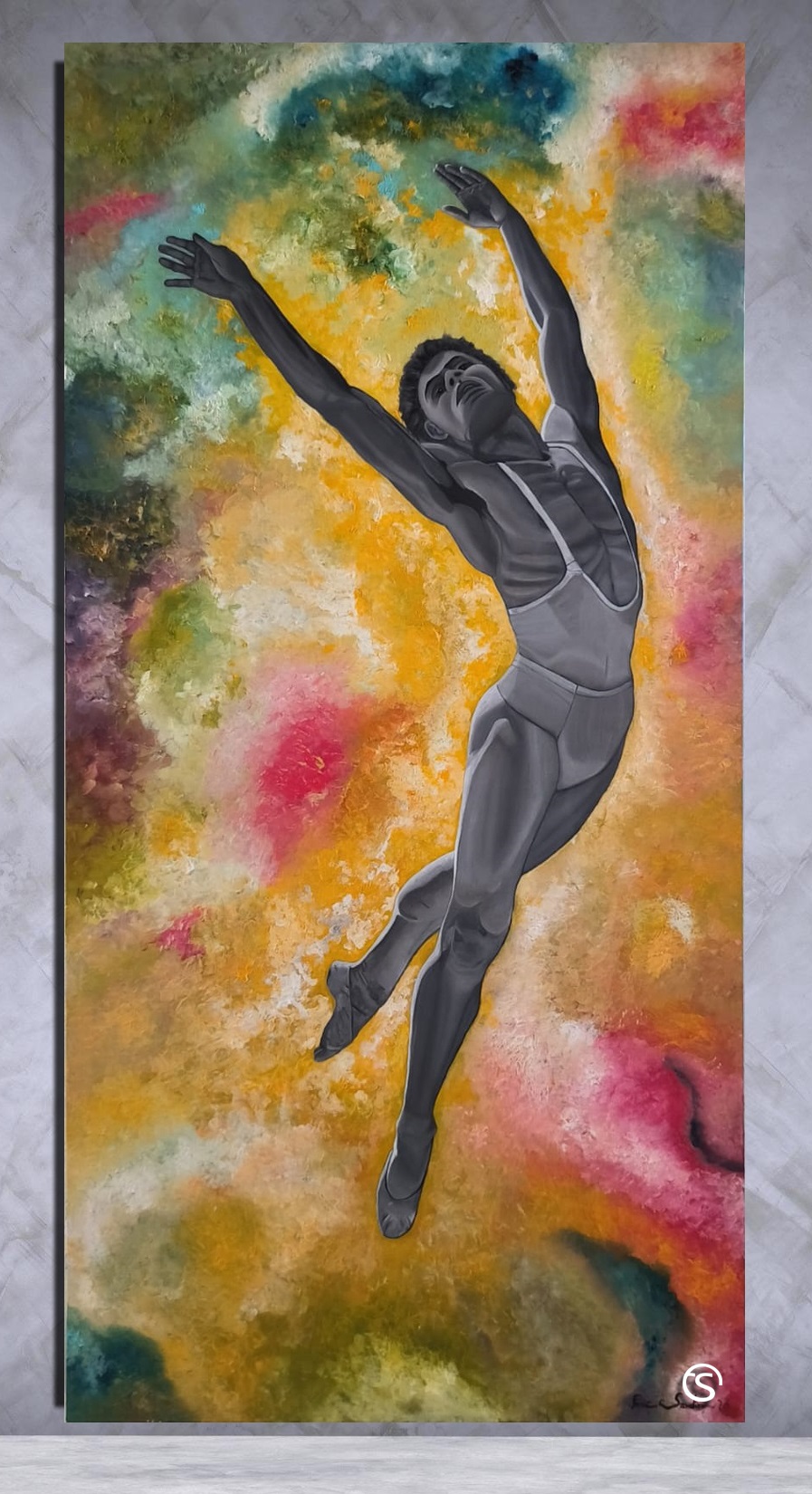
Rudy
Year: 2026
Dimensions: 60 x 120 cm
Technique: Oil
Code: FS_2026_001
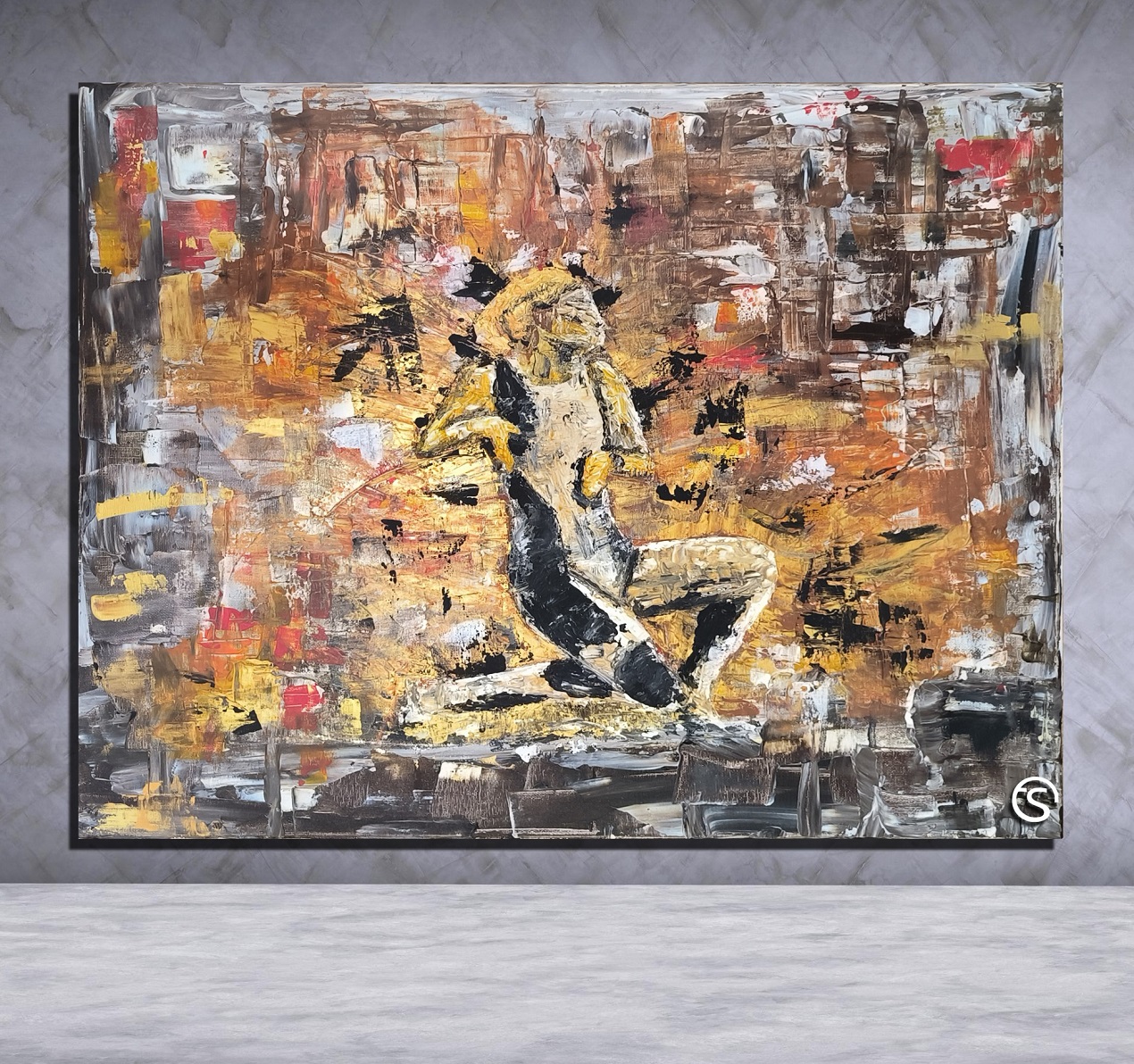
Inspired by Rudolf Nureyev, this work depicts the price and greatness of absolute dedication to art. The body suspended in space expresses strength, tension and abandonment at the same time: it is the result of rigorous work, extreme discipline and radical choices that often lead the artist to solitude. The figure leans upwards as if trying to overcome human limits, embodying the daily sacrifice necessary to achieve perfection. Every muscle is a memory of hours of study, sacrifice and isolation, all concentrated in a gesture that lasts a millisecond but encompasses an entire life. The vibrant, textured background amplifies the idea of energy and transcendence, while the dancer’s gesture becomes a symbol of an unrepeatable moment. The work invites us to reflect on the importance of the moment: it is there, in that fragment of suspended time, that art is accomplished and eternity manifests itself.
Another World
Year: 2025
Dimensions: 60 x 60 cm
Technique: Acrylic
Code: FS_2025_002
Another world” is a work that depicts the silent encounter between two beings and a planet still undergoing transformation. The figures on either side, distant and mirrored, observe a world in evolution without intervening, like conscious witnesses to a process that must unfold autonomously. In the centre, the expanse of rocks like skyscrapers and walls stands as a clear barrier between heaven and earth. Architecture, a symbol of human ingeniousness but also of its need for control, interrupts the natural dialogue between the two dimensions, creating separation, distance and rigidity. Above, the sky remains fluid, energetic and vital; below, the earth retains organic and pulsating forms, a memory of an origin that is still alive. The work reflects on the growth of civilisations and the price of progress: as the observed world structures and defends itself, it risks losing touch with cosmic harmony. Another world invites us to question the direction evolution is taking and how necessary it is to rebuild a balance between what we build and what we are.
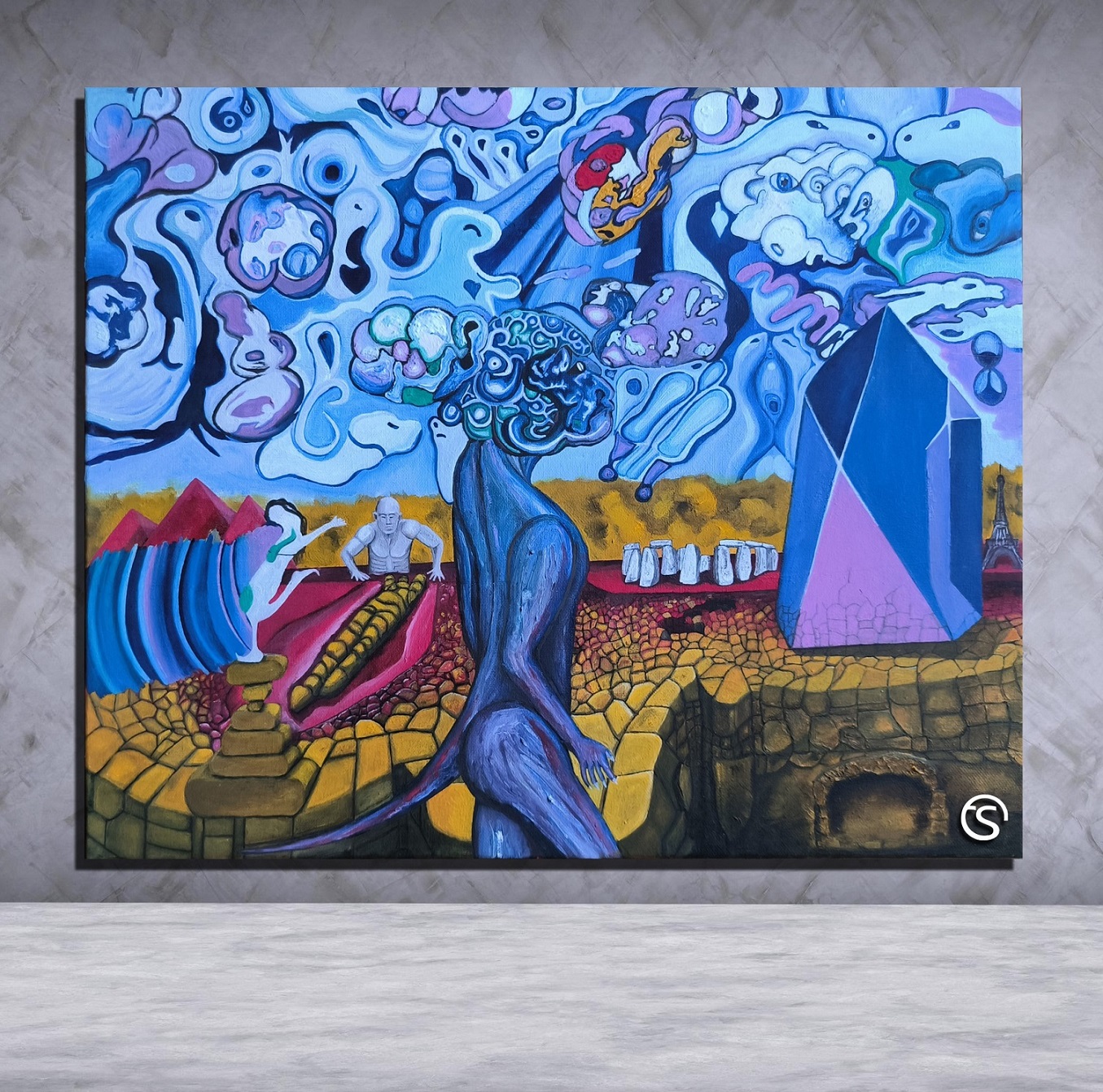
Starlight
Year: 2024
Dimensions: 60 x 50 cm
Technique: Oil
Code: FS_2024_003
Starlight is a work that depicts a new birth on the ruins of ancient civilisations, in a landscape marked by time, destruction and memory. The being at the centre of the scene emerges as a hybrid and conscious creature, generated by what has been and projected towards what can still be. Around him are layered fragments of past worlds: architecture, symbols, suspended human gestures, like traces of civilisations that sought order, power and knowledge. Above, the sky is crossed by fluid and visionary forms, matter of thought and cosmic consciousness, where the stars become language and guidance. The crystal, placed as a central element of connection, is the point of balance between earth and sky. It guards invisible harmonies, channels the light of the stars and allows the being to rediscover a connection with the universe, beyond chaos and ruin. It is not an object of domination, but of listening and agreement. The work suggests that, even after the collapse of civilisations, a form of life capable of reconnecting with the cosmos can arise, restoring balance and harmony. The light of the stars is a vision of rebirth, in which the memory of the past becomes the foundation for a new universal consciousness.
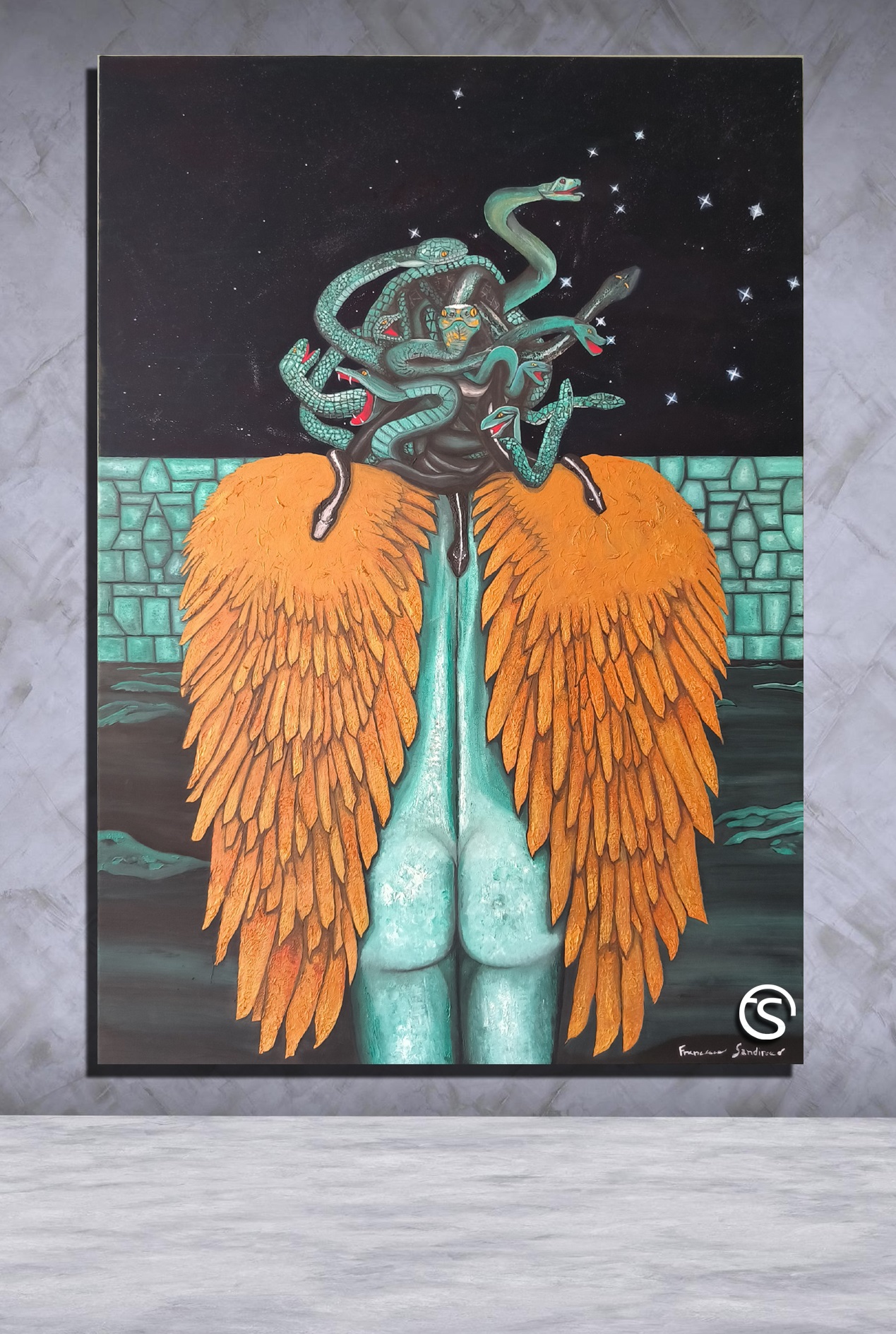
Pegaso
Year: 2023
Dimensions: 70 x 100 cm
Technique: Oil
Code: FS_2023_001
Pegasus is a work that overturns the collective imagination linked to a figure, Medusa, often reduced to a symbol of cruelty and danger, restoring her tragic and deeply human origins. Medusa was a beautiful priestess of Athena, consecrated to the purity and silence of the temple. Her transformation into a monster was not a fault, but a punishment: after being raped by Poseidon in the sacred place, she was punished by the goddess for the desecration, deprived of her beauty and transformed into a creature with a petrifying face and hair made of snakes. The snakes thus became a symbol of imprisonment and isolation. Medusa was forced to live separated from the world, unable to be approached, unable even to return a glance without condemning those in front of her. Her monstrosity did not stem from evil, but from pain, injustice and imposed loneliness. From her death, however, Pegasus is born, the semi-divine winged horse, symbol of rebirth, freedom and transcendence. The presence of Pegasus is evoked by the arrangement of the stars in the sky in the work, as if the cosmos itself held the memory of Medusa and her final transformation. Ultimately, her head becomes a weapon: no longer an instrument of personal defence, but an object of power in the hands of others, a further sign of a life used and never truly redeemed. The work invites us to reinterpret the myth as a story of violence and punishment, but also of transformation: from the deepest pain, something eternal can be born. Medusa is not only a monster, but a victim who, through tragedy, generates myth, power and memory.
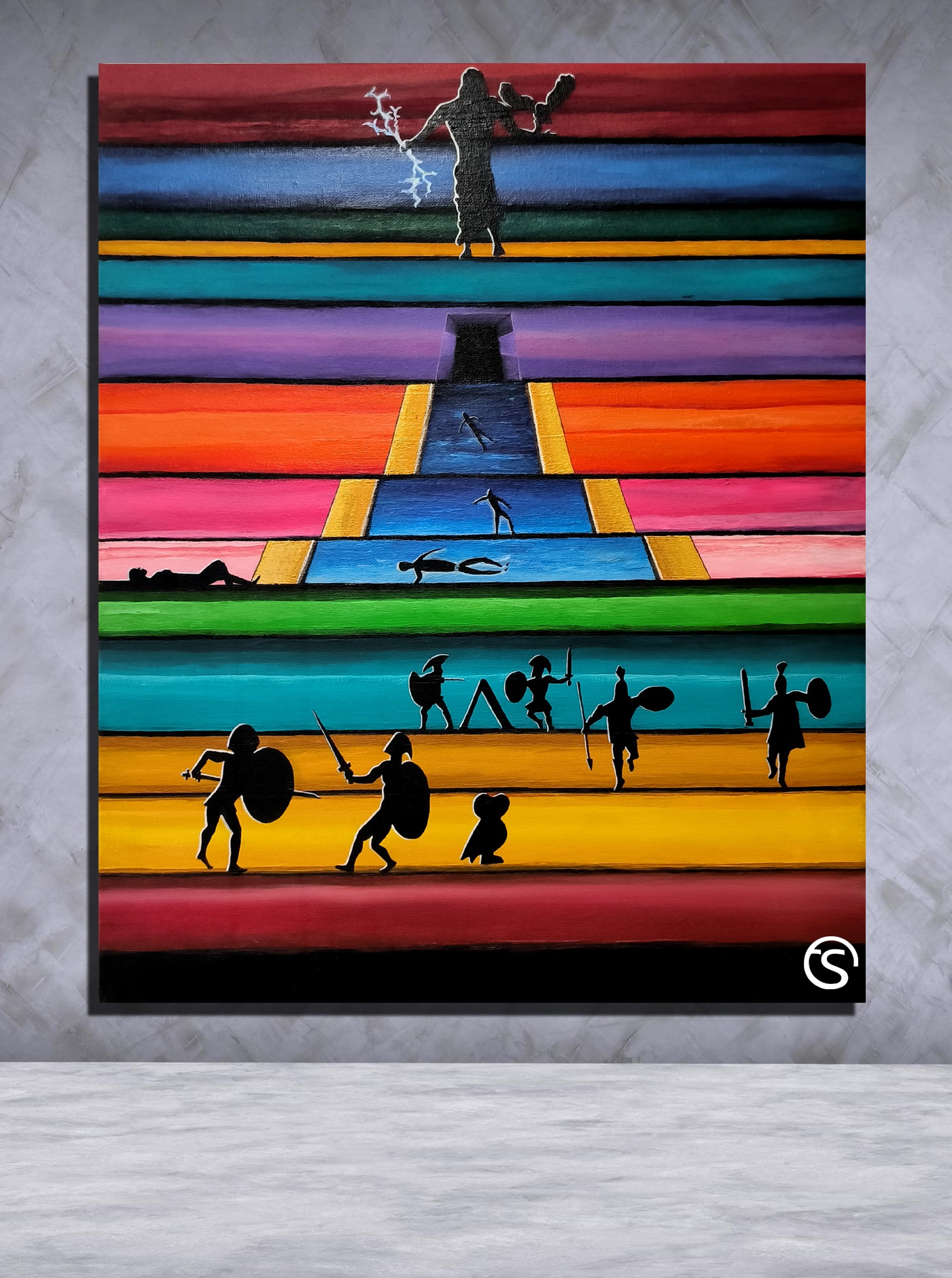
The Big Theatre
Year: 2021
Dimensions: 50 x 60 cm
Technique: Acrylic
Code: FS_2021_001
“The BigTheater” is a work that portrays human existence as a vast staged performance, unfolding across multiple levels, where humanity struggles, falls, dies, and is reborn in an endless cycle. Each level represents a phase of life: struggle, sacrifice, illusion, hope, and faith in “earthly” divinities—constructed by human beings themselves to give meaning to their journey. The figures, reduced to archetypal silhouettes, act as unaware performers in an eternal drama, repeating gestures that transcend time. Above, a dominant presence appears to govern or observe, while at the center a doorway opens toward infinity—a mysterious, inevitable, and unknown passage that no one can truly comprehend. The work suggests that even while aware that ultimate truth remains beyond reach, humanity continues to believe, to fight, and to begin again. “The Great Theater” thus becomes a powerful reflection on the human condition: an existence lived upon the world’s stage, suspended between the need for certainty and the inevitable attraction to the unknown.
Roberto
Year: 2020
Dimensions: 60 x 100 cm
Technique: Acrylic
Code: FS_2020_003
Roberto is an intimate and deeply emotional work, dedicated to the artist’s brother, a great musician who passed away far too soon. The portrait, essential and direct, conveys an intense and silent gaze filled with presence despite absence. The piano that runs through the figure becomes a symbol of music as an extension of the soul, a language that continues to live beyond time and matter. The word Legend is not a rhetorical celebration, but a sincere acknowledgment of a talent and a bond that death cannot break. The work also emerges as a necessary act of letting go of pain: painting becomes a gesture of processing and release, a way to transform loss into shared memory. The background, delicate yet vibrant, envelops the face like an affectionate presence made of memories, emotions, and music that continues to resonate. Roberto is an act of love, farewell, and eternity.
Andromeda
Year: 2020
Dimensions: 70 x 50 cm
Technique: Acrylic
Code: FS_2020_005
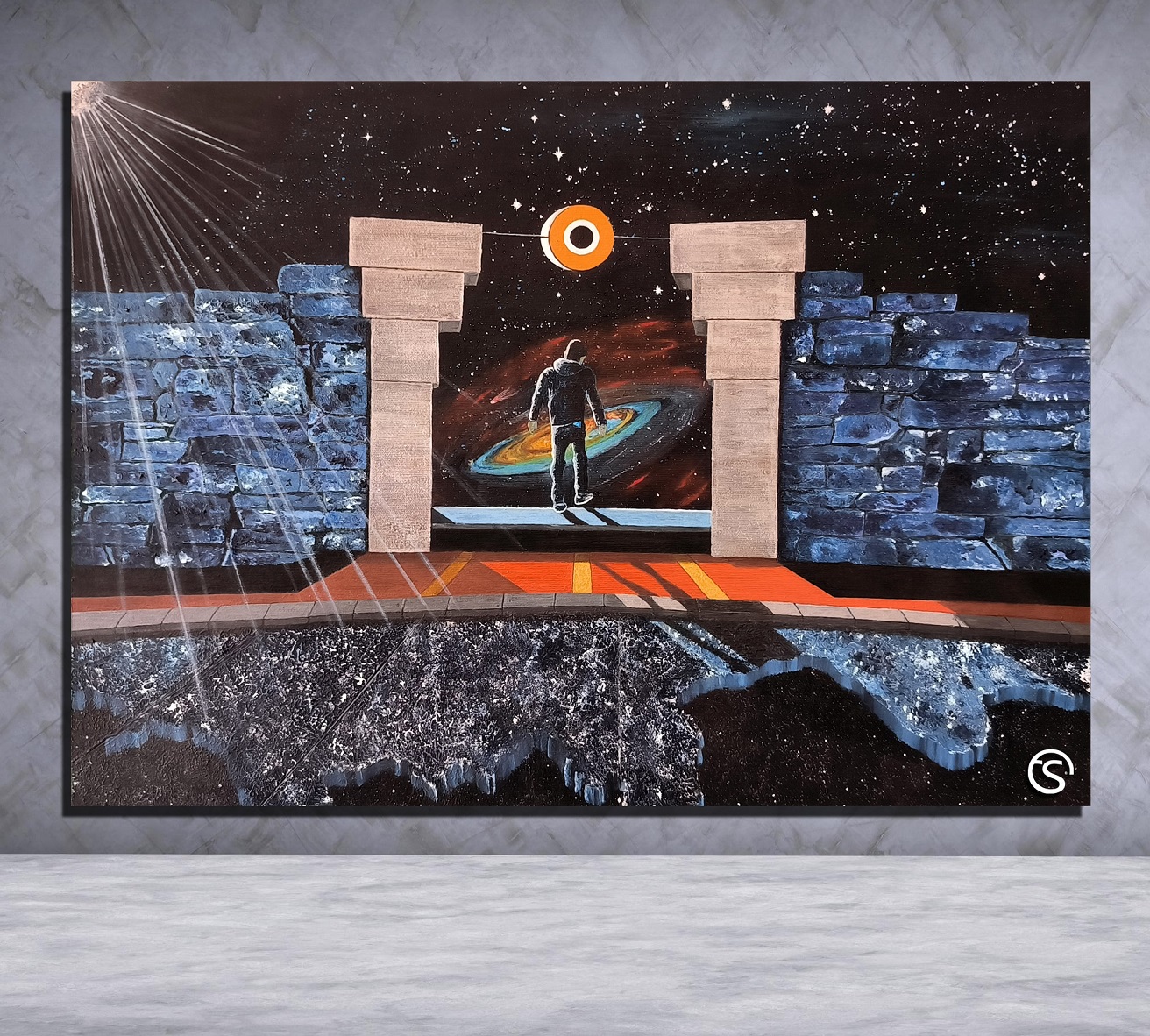
Andromeda is a work set in the Teatro Andromeda in Santo Stefano di Quisquina, a place suspended between earth and sky, where architecture and cosmos engage in symbolic dialogue. The figure at the center stands on a threshold, between two columns that mark a passage, while before them opens the vastness of the Andromeda constellation—a metaphor for the infinite and the unknown. The ground beneath their feet lies fractured and unstable, a sign of dissolving certainties that make the leap inevitable. It is not a fall, but an act of trust: the abandonment of earthly limits in order to reach toward something greater. Light and cosmic space draw the figure forward, suggesting an irresistible inner call. The work captures the precise moment when a human being, stripped of secure footholds, chooses to go beyond, transforming risk into possibility. Andromeda thus becomes a symbol of the passage from the human to the cosmic, from the finite to the infinite.
The Salt of the Earth
Year: 2019
Dimensions: 50 x 70 cm
Technique: Acrylic
Code: FS_2019_004
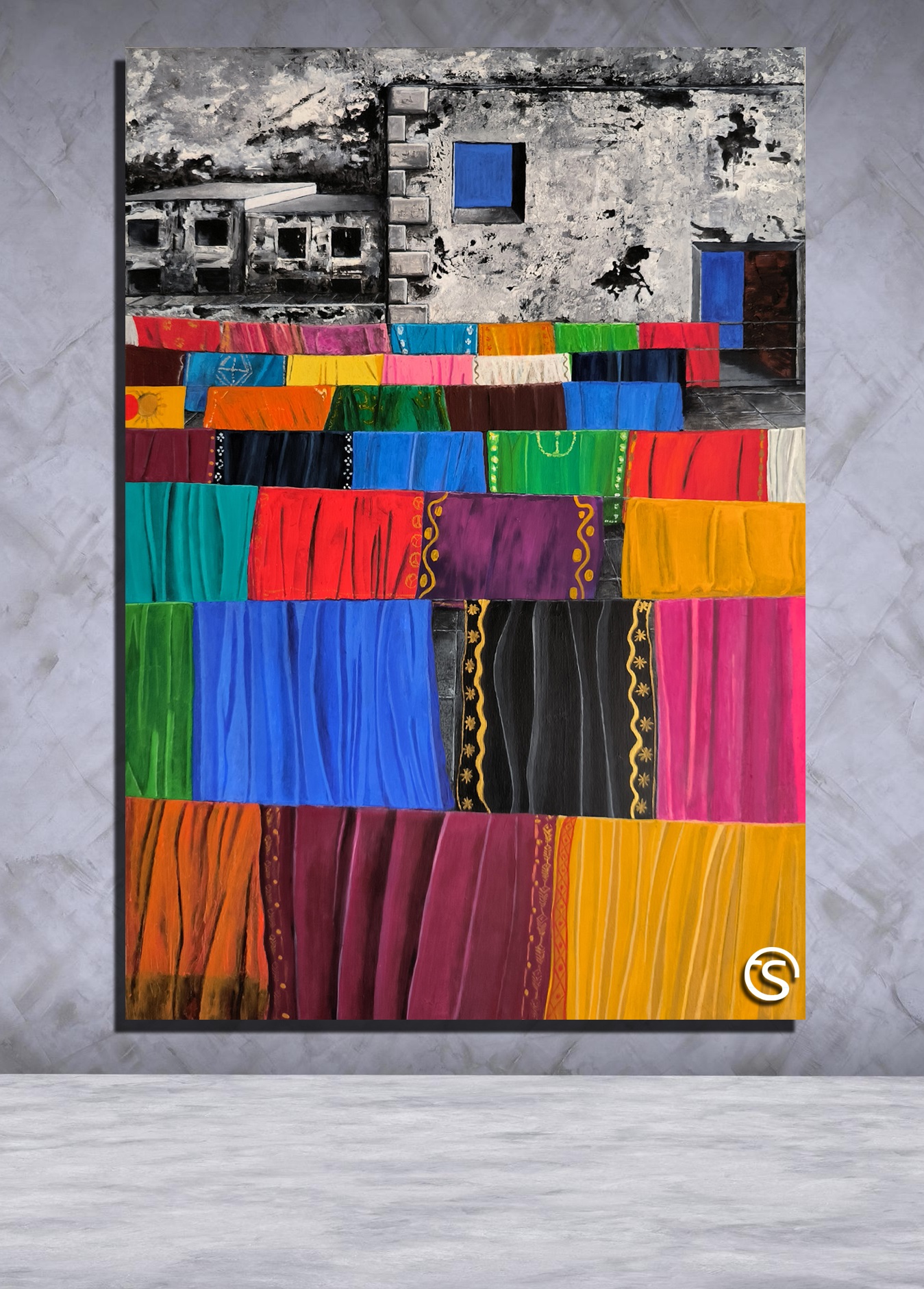
The Salt of the Earth is a work inspired by the human and artistic journey of Sebastião Salgado, witness to the great wounds of the world but also to its possible redemption. As in the photographer’s works, the painting arises from a gaze directed at desolation, ruin and the harshness of reality, represented by the grey, worn and fragile background, a sign of destruction and abandonment. In contrast, the intense and vibrant colours that occupy the scene become an expression of the beauty that man is still capable of creating. They are traces of life, culture, identity and resistance, which emerge even in the harshest contexts. The work suggests that, despite the ugliness documented and experienced, there is a deep hope in human beings: the ability to generate meaning, colour and dignity even where everything seems lost. “The Salt of the Earth” is an act of faith in humanity, an invitation to recognise that even in the cracks of the world, the possibility of salvation can still arise.
The Tree of Life
Year: 2020
Dimensions: 80 x 60 cm
Technique: Acrylic
Code: FS_2020_006
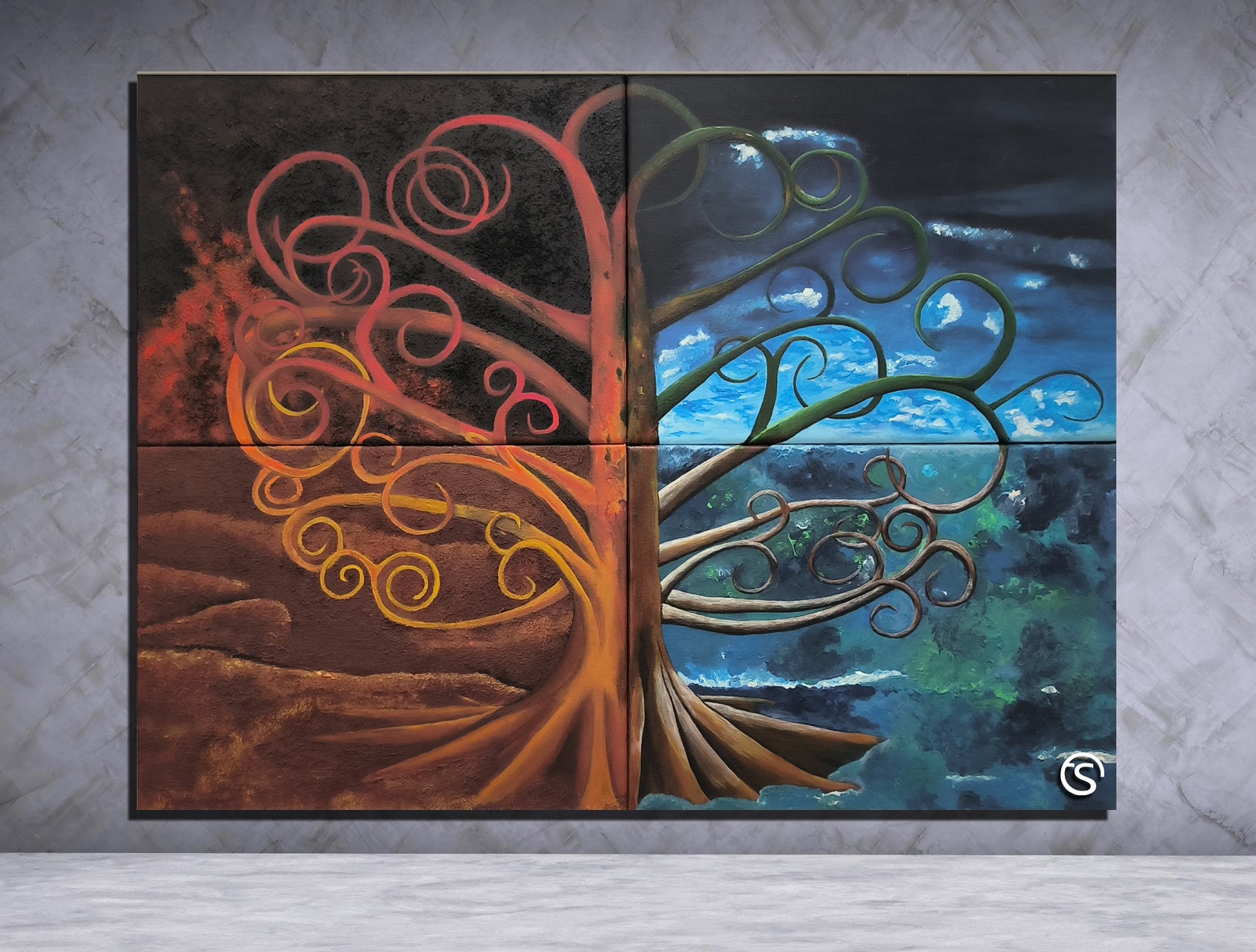
The Tree of Life is a work composed of four distinct panels that, when joined together, form a single symbolic vision: the origin of life arises from the balance and interaction of the four fundamental elements—earth, fire, air, and water. Each panel represents one element and is created using a technique consistent with its essence. Earth is expressed through a textured painting made with actual soil, dense and tangible, the root and foundation of all forms of existence. Fire takes shape through the ashes of Mount Etna, a living and primordial material that carries within it the volcano’s destructive and generative power. Air is evoked through thin, essential brushstrokes—light and in motion—suggesting breath, thought, and the invisible. Finally, water is fluid and enveloping, with rich, deep colors flowing across the surface like vital currents. The tree, extending across the four panels, becomes a symbol of connection: its roots sink into matter, its trunk passes through the elements, and its branches expand into space. The work invites us to recognize that life exists only through the harmony of diverse forces, united in a fragile yet essential balance. The Tree of Life thus becomes a celebration of nature as an interconnected system, in which every element is indispensable to the others.
The Swan
Year: 2019
Dimensions: 60 x 50 cm
Technique: Acrylic
Code: FS_2019_003
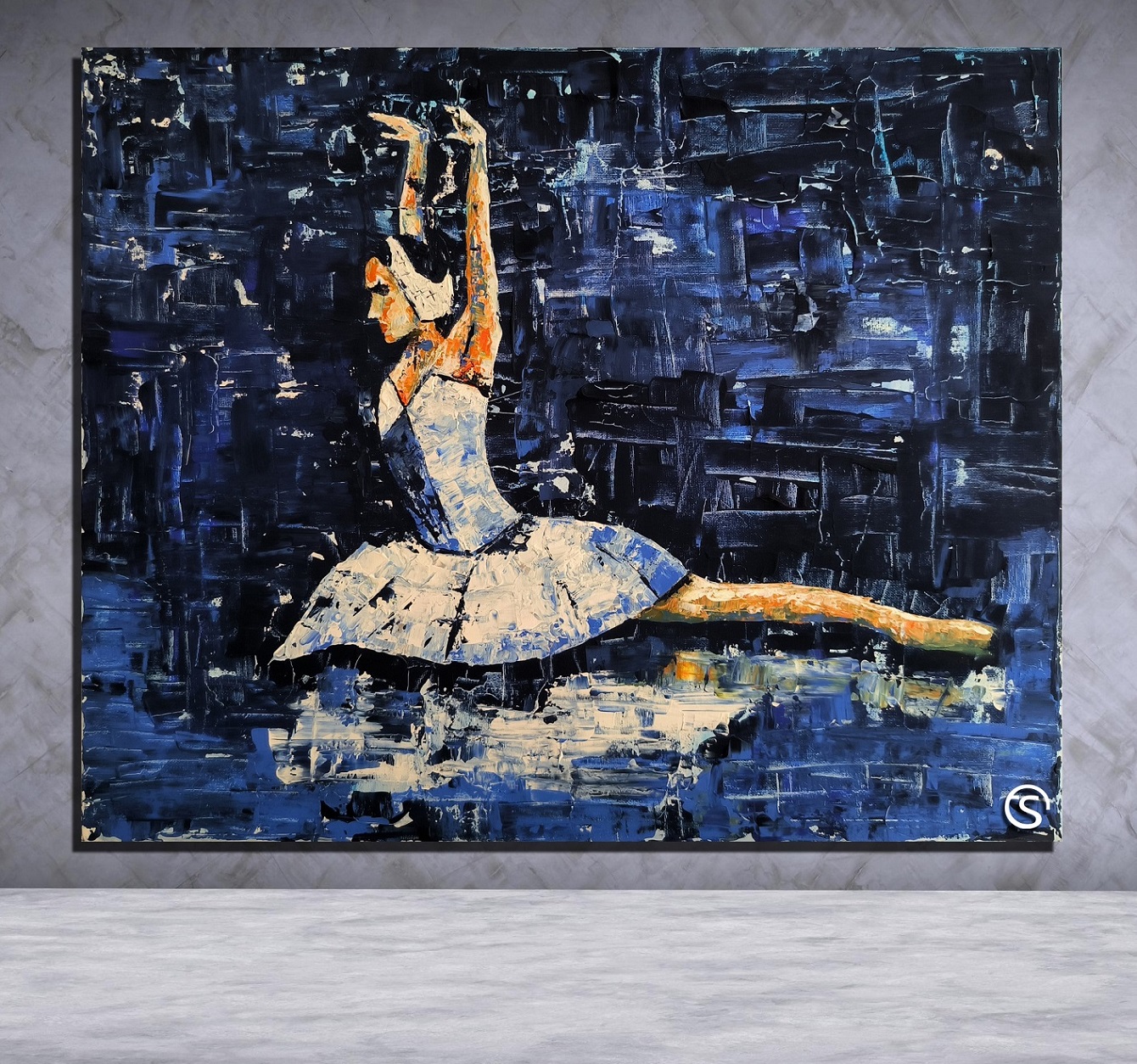
“The Swan” is a work inspired by The Dying Swan, a choreographic solo created by Michel Fokine to the music of Camille Saint-Saëns’ The Swan, taken from The Carnival of the Animals. The piece is a tribute to the beauty, elegance, and dignity that accompany life’s final moment. The dancing figure emerges from a deep, nocturnal background, as if suspended in time, while the movement of the body expresses a conscious and poetic farewell. The swan, symbolically embodied by the dancer, does not struggle against the end but passes through it, transforming it into a harmonious gesture. Every line, every tension in the body conveys grace and control, celebrating life precisely at the moment of its departure. Dance becomes a ritual—an ultimate act of beauty and awareness. The work suggests that even an ending can be luminous when experienced with elegance and truth: a final movement that is not defeat, but a celebration of the very essence of existence.
Un faune
Year: 2019
Dimensions: 60 x 50 cm
Technique: Acrylic
Code: FS_2019_002
“A Faun” is a work inspired by the grace of Nijinsky, an icon of a form of dance capable of uniting formal purity with inner tension. The figure emerges from dense, fragmented matter, as if the body were sculpted from the chaos of emotions and desires. The faun, elegant in gesture and movement, embodies an ambiguous beauty: grace coexists with pride, harmony with restlessness. Lost in his own impulses, the character dances within a space that is not a refuge but a mirror of his interior world, where instinct prevails over restraint and desire becomes the dominant force. The work thus offers an intense and fragile image of the human being, capable of expressing sublime beauty even while imprisoned by personal contradictions. “A Faun” is both a celebration and a reflection on the subtle line that separates grace from disorientation.
Music And Me
Year: 2019
Dimensions: 60 x 50 cm
Technique: Acrylic
Code: FS_2019_001
Music and Me is an intense and introspective self-portrait in which the artist explores the deep connection between identity and music. The face, fragmented by textured marks and overlapping layers of color, conveys a living and vulnerable presence, shaped by emotions, thoughts, and inner stratifications. The headphones become the symbol of an intimate and protected space—an inner realm where music acts as a source of inspiration, refuge, and creative drive. Through sound, the artist isolates from external noise in order to enter into dialogue with the self, transforming listening into introspection. The energetic and irregular brushwork reflects the rhythm of music and the flow of thoughts, suggesting that creativity arises precisely from the meeting between deep listening and authentic expression. Music and Me thus becomes the portrait of an identity that is shaped and revealed through music—the universal language of the soul.
Casta diva
Year: 2020
Dimensions: 40 x 30 cm
Technique: Acrylic
Code: FS_2020_004
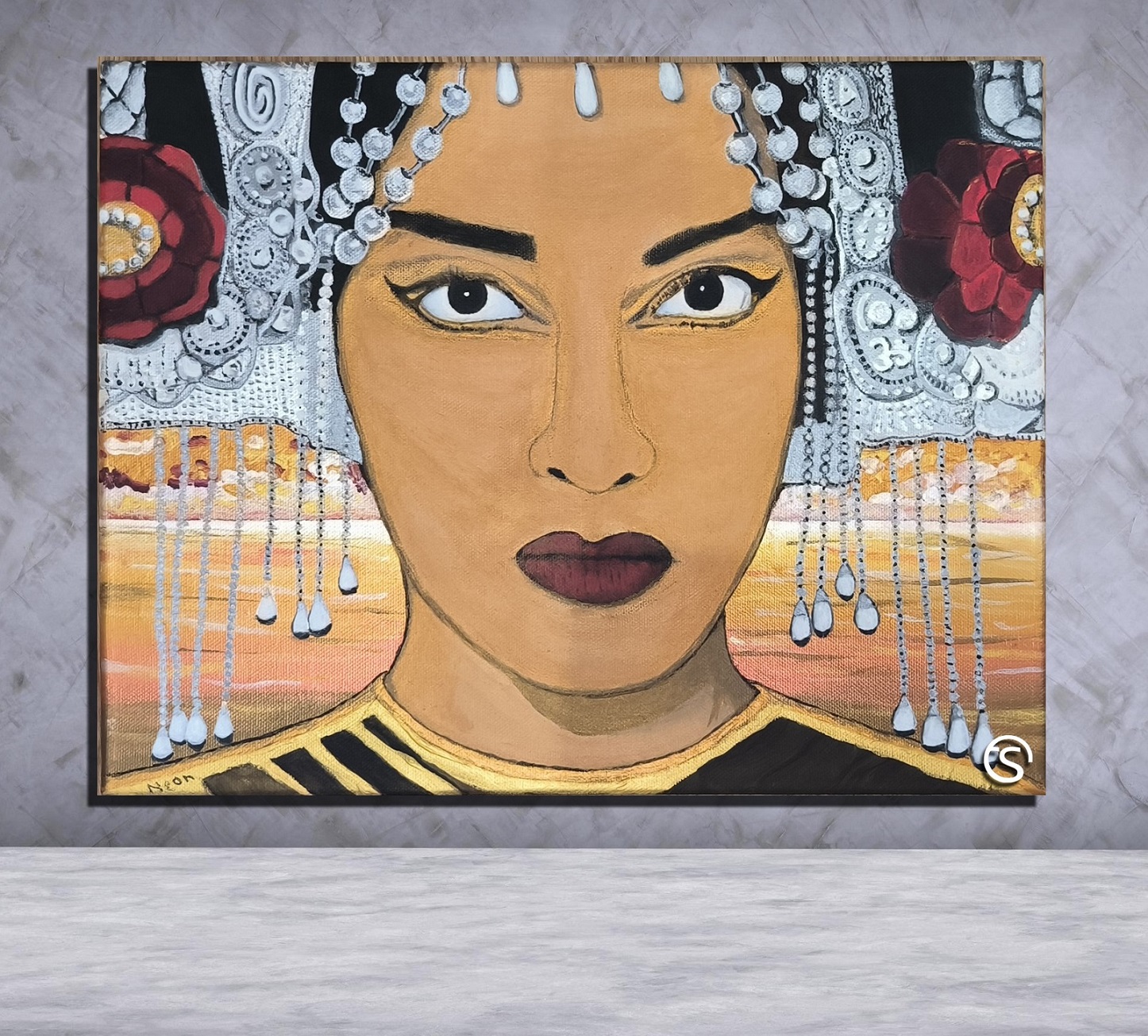
Casta Diva is a work inspired by the interpretation of Maria Callas, a symbol of a perfection that in art is not coldness, but absolute intensity and emotional truth. The face, solemn and frontal, evokes an almost sacred dimension, where every detail becomes a ritual gesture and an act of consecration. The gaze is steady, deep, suspended between the human and the divine: it is the space where Callas’s voice transforms into prayer, capable of elevating the soul beyond time. The rich and luminous ornaments evoke the sacredness of song and the rigorous discipline required to achieve excellence. The work suggests that artistic perfection does not arise from the absence of fragility, but from their sublimation.In Casta Diva, art becomes the place where the human is transfigured, reaching a form of absolute and uncompromising beauty.
The Sun
Year: 2018
Dimensions: 30 x 50 cm
Technique: Acrylic
Code: FS_2018_002
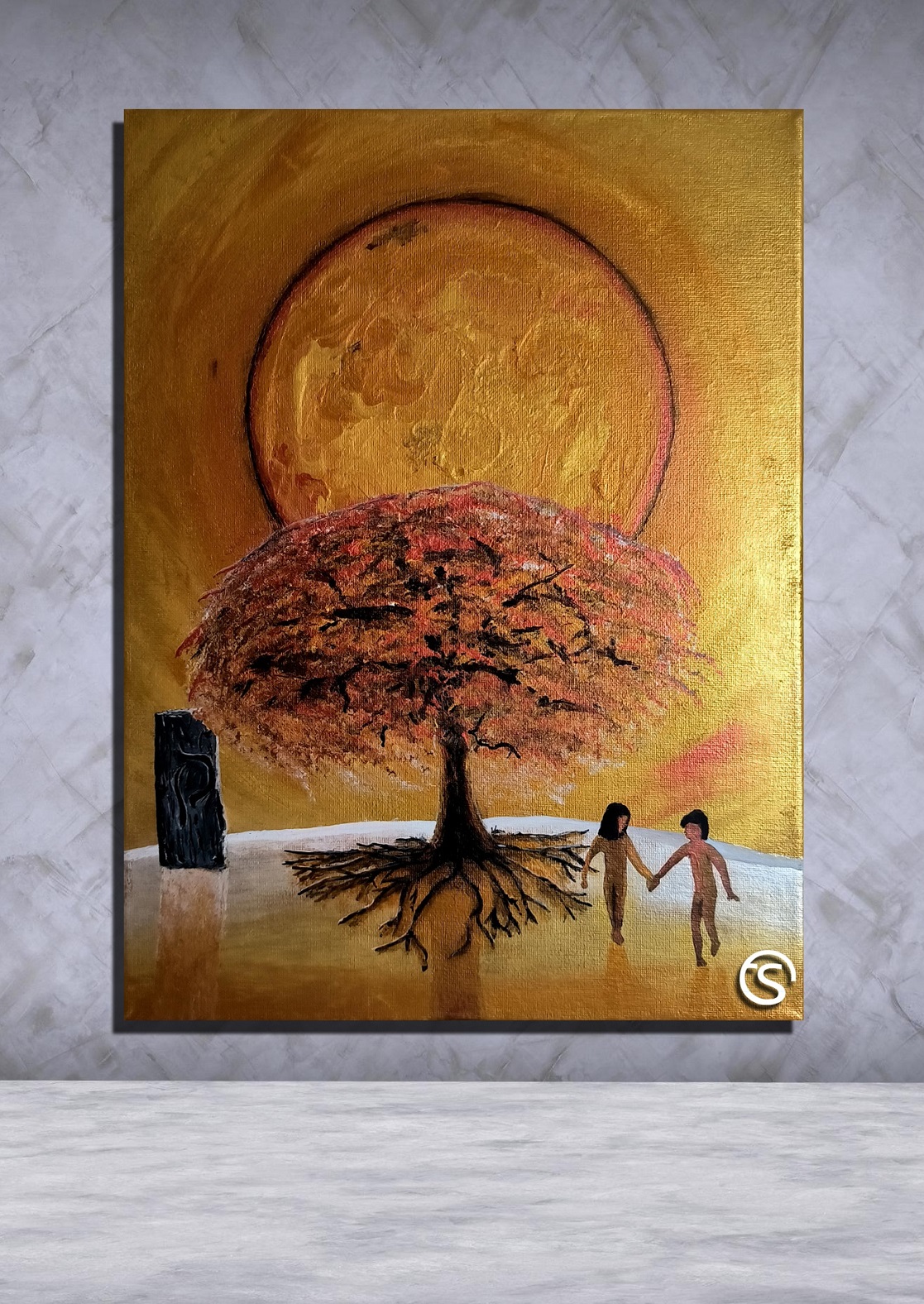
“The Sun” recalls the archetypal meaning of the Sun card in the tarot: the principle of life, clarity and revealed truth. The large sun dominates the scene, radiating a warm and enveloping light that nourishes the tree, a symbol of growth, rootedness and continuity between heaven and earth. In its light, purity and the works of man coexist harmoniously: the simple and united human figures represent innocence, trust and a shared journey, while the traces left by man bear witness to human activity under the same sky. The sun does not judge, but illuminates everything indiscriminately, making visible what is authentic. The work suggests that only through the light of consciousness and truth is it possible to give meaning to both inner nature and what man creates in the world.
The Art of Courage
Year: 2018
Dimensions: 50 x 50 cm
Technique: Acrylic
Code: FS_2018_003
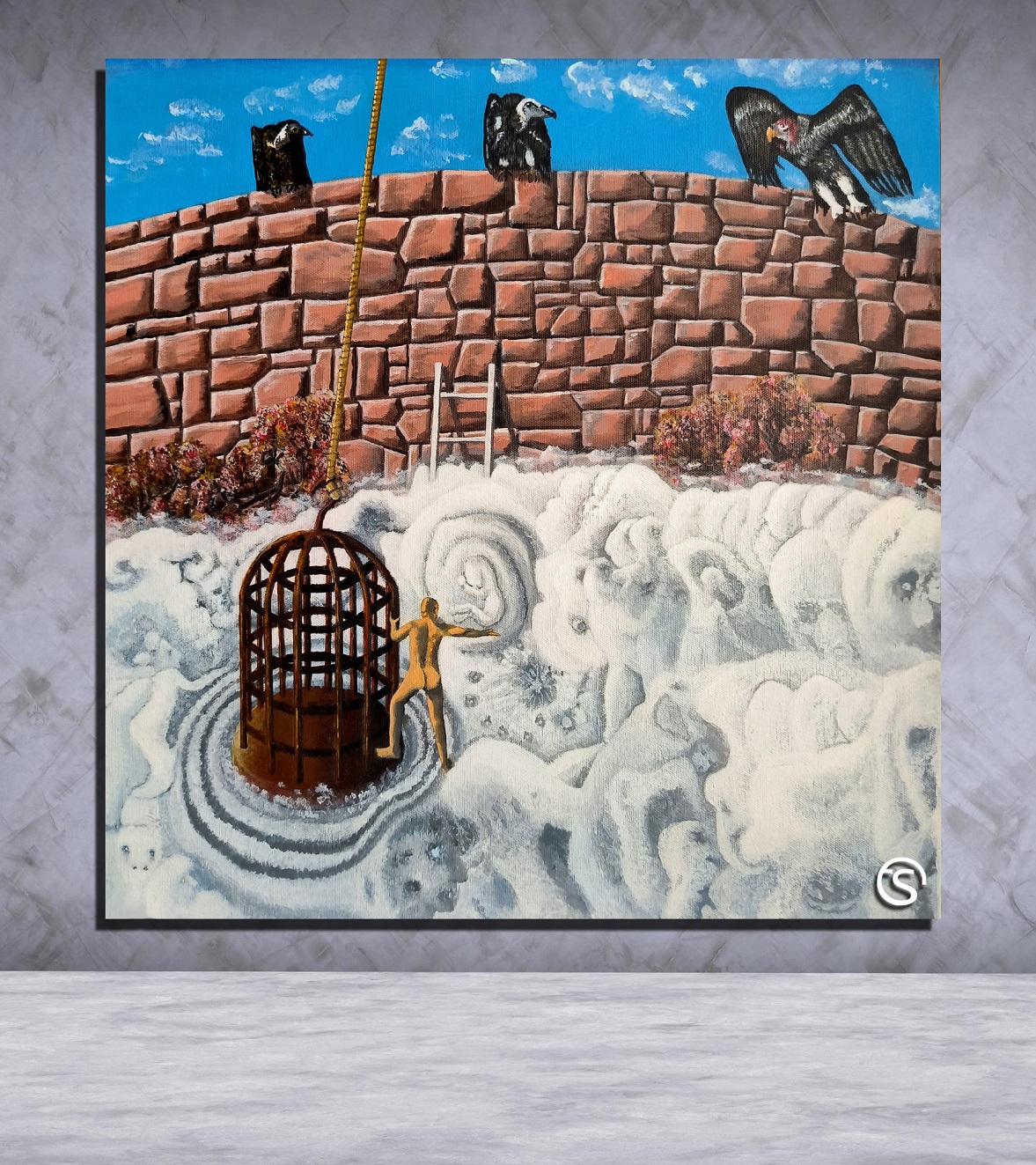
“The Art of Courage” is a work that depicts the search for truth as an extreme and necessary act, a journey that involves the risk of crashing against one’s own limits in order to overcome them. The central character, naked, advances defenceless: nudity becomes a symbol of total dispossession, of the abandonment of masks, fears and certainties in order to go beyond the boundary. The cage and the wall represent internal and imposed barriers, while the vultures, placed above, are the silent guardians of the limit, stern observers of those who dare to challenge it. The dense, textured clouds evoke the complexity of thoughts, the mental chaos that accompanies every radical choice. The work suggests that true courage is not the absence of fear, but the willingness to face it, even at the cost of an impact, in order to get closer to a more authentic truth.
Lights and Shadows
Year: 2017
Dimensions: 50 x 40 cm
Technique: Acrylic
Code: FS_2017_001
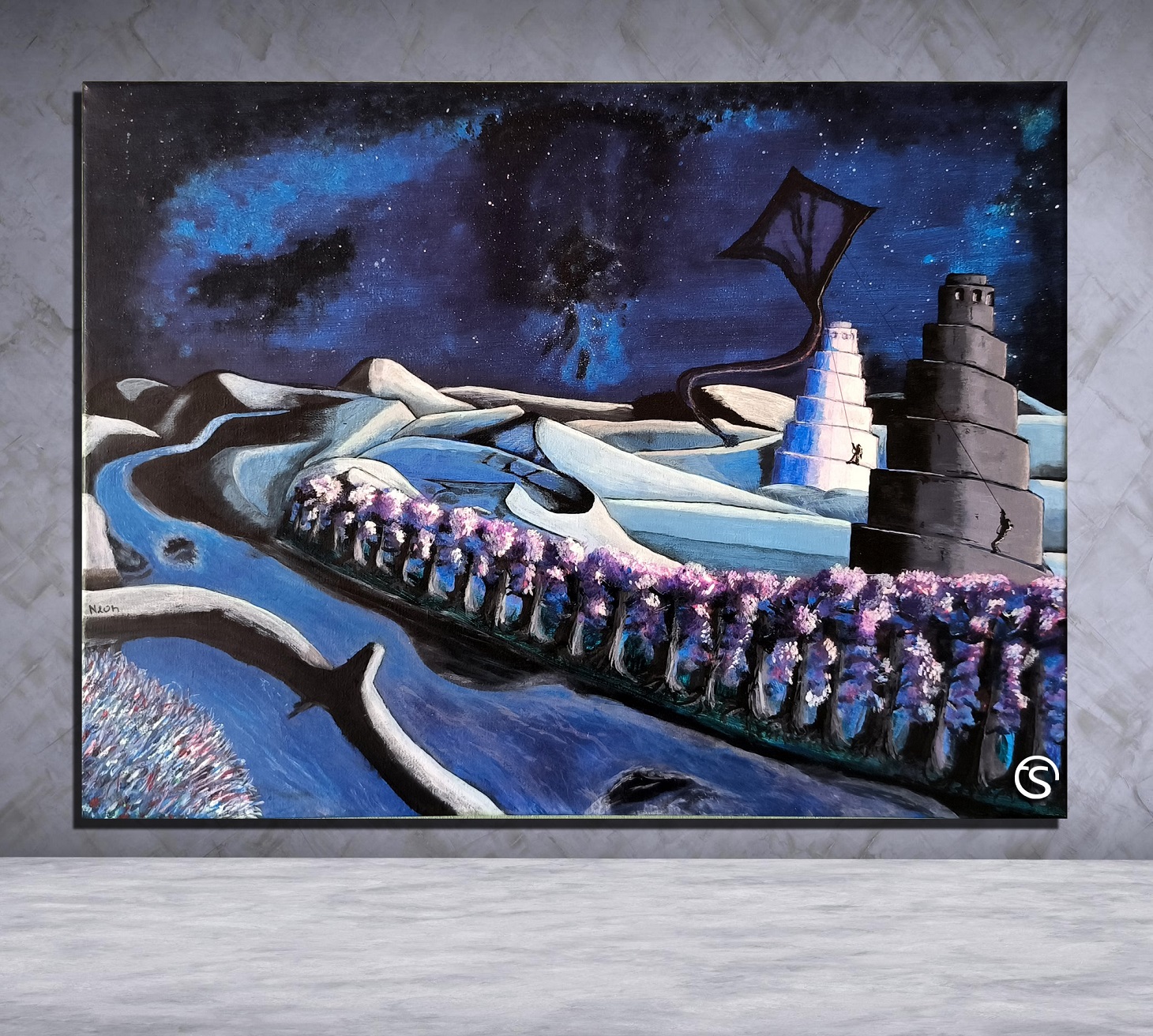
“Lights and Shadows” represents the search for balance between light and darkness as an essential condition of existence. A suspended, nocturnal landscape forms the backdrop to two opposing towers—one white and one black—symbols of complementary polarities. Two human figures climb them while pulling the same kite, which remains balanced only through their shared tension. No force prevails over the other: stability arises from the coexistence of opposites. The work suggests that harmony does not come from choosing a single direction, but from the ability to keep light and shadow in dialogue.
Anche nel mio sito uso un pizzico di “colore digitale”: i cookie aiutano a offrirti la migliore esperienza sul sito. Continuando la navigazione, accetti l’impiego dei cookie in conformità alla nostra informativa.